

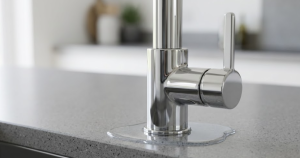
You walk into the kitchen and spot a small puddle of water, but it isn’t dripping from the spout; instead, it is pooling right at the bottom where the metal body meets the sink deck.
This is a classic problem. Kitchen tap leaking at the base is frustrating. Most people assume a nut has come loose. They try to tighten it. But the leak usually comes back.
In single-lever mixers, a base leak is rarely about a loose screw. It is a symptom of internal wear. It signals a failure in the dynamic sealing system. This involves friction, water pressure, and the quality of the brass machining.
Here is a look at the mechanical reasons why single-lever kitchen mixers often leak at the base over time and the engineering reality behind the failure.
1. The Swivel Spout: Friction vs. Sealing
Bathroom taps are often fixed. But a kitchen mixer needs to move. It swivels left and right. This movement creates a unique engineering challenge.
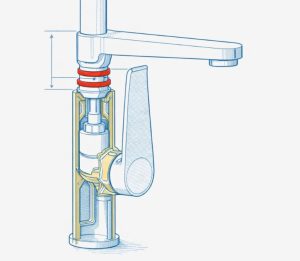
The spout sits on top of the main body. It floats on two rubber O-rings. These rings are coated in grease. Every time you move the spout, you create friction.
If you have a kitchen tap mixer leaking from the middle or base, it is often due to “machining tolerance.”
- The Gap: There is a tiny gap between the brass body and the rotating spout. If this gap is too wide, the O-ring expands too much. It tears.
- The Grind: If the gap is too tight, the metal grinds the rubber flat.
Over thousands of turns, the rubber wears down. Water escapes the channel. Gravity pulls it down. It pools at the base. This is why precision-engineered mixers rely on strict CNC tolerances to keep that gap perfect for years.
2. The Cartridge Seating: The Hidden Bypass
The ceramic cartridge is the engine of the faucet. It controls the flow. But it must sit on a perfectly flat floor inside the brass body.
Sometimes, the leak starts here.
- Rough Casting: If the brass floor inside the mixer has rough spots or sand holes, the cartridge gasket cannot seal. Water slips under the cartridge.
- Thermal Shock: Kitchen taps switch rapidly between boiling hot and freezing cold water. This makes the metal expand and contract. Over time, this movement can loosen the large nut that holds the cartridge down.
If you notice the kitchen sink drips when turned off, the cartridge seal might be broken. The water bypasses the valve. It fills the hollow body of the tap and slowly seeps out of the bottom threading.
3. Hydrostatic Shock (Water Hammer)
Single-lever mixers are convenient. You can flip them closed instantly.
But this speed creates a problem called “Water Hammer.” When you stop the water fast, a shockwave hits the valve. It creates a massive pressure spike inside the mixer body.
This pressure looks for a weak point. In an older faucet, the weakest point is often the base seals. Repeated shockwaves can push the O-rings out of their grooves. It is not just a leak; it is a sign of system stress.
4. Supply Line Tension (Side-Loading)
Sometimes, the mixer is fine. The problem is the installation below the counter.
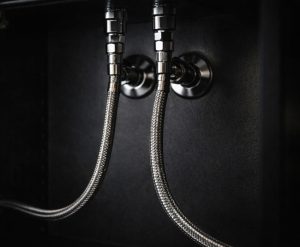
Kitchen mixers connect to the water supply with flexible braided hoses.
- The Issue: If these hoses are too short, they pull tight. Or, if they are twisted during installation, they create “side-load” tension.
- The Result: This tension pulls on the copper inputs at the base of the mixer. It deforms the O-rings where the hose enters the tap.
Water leaks from this connection. It travels up the threads, and appears on top of the sink, looking like a base leak. But the root cause is actually tension under the cabinet.
Conclusion
A puddle at the base of your mixer is not a mystery. It is the result of physics. It comes from rotational friction, thermal expansion, and hydraulic shock.
A long-lasting mixer depends on two things: the quality of the rubber seals (like EPDM) and the precision of the metal cutting. Tightening a nut might help for a day. But choosing reliable kitchen flow control systems with correct machining tolerances is the only way to prevent leaks for the long term.
Engineering Reliability into Water Flow
ITAVA approaches sanitary ware manufacturing with a focus on dimensional precision. Established in 2010, the company prioritizes the machining tolerances of the brass body to ensure dynamic seals—like those in swivel spouts—maintain integrity over years of use.
By using high-grade EPDM seals and conducting rigorous water hammer testing, ITAVA designs mixing valves that withstand the thermal and physical stresses common in commercial and residential kitchens. The goal is to create systems where the internal engineering is as durable as the external finish.
FAQ
Q1: Can I just tighten the screw to stop the leak?
A: Usually, no. If the leak comes from the swivel point, tightening the grub screw only limits movement. It does not fix the worn O-ring inside.
Q2: Why does it leak only when I move the spout?
A: This confirms the O-rings are the problem. When you turn the spout, you deform the worn rubber seals. This creates a temporary gap for water to escape.
Q3: Does the cartridge cause leaks at the bottom?
A: It can. If the cartridge is cracked or the rubber gasket under it is flat, water flows around the cartridge. It fills the body cavity until it spills out the bottom.
Q4: How long should a kitchen mixer seal last?
A: In a busy kitchen, the O-rings typically last 5 to 7 years. However, high-quality mixers with smoother internal machining can extend this lifespan significantly.
Q5: Is it the tap or the sink causing the water pool?
A: Check the seal between the tap and the sink deck. If the water oozes from under the metal body, it is the mixer. If it is just splashing from washing dishes, it is likely just surface water.