

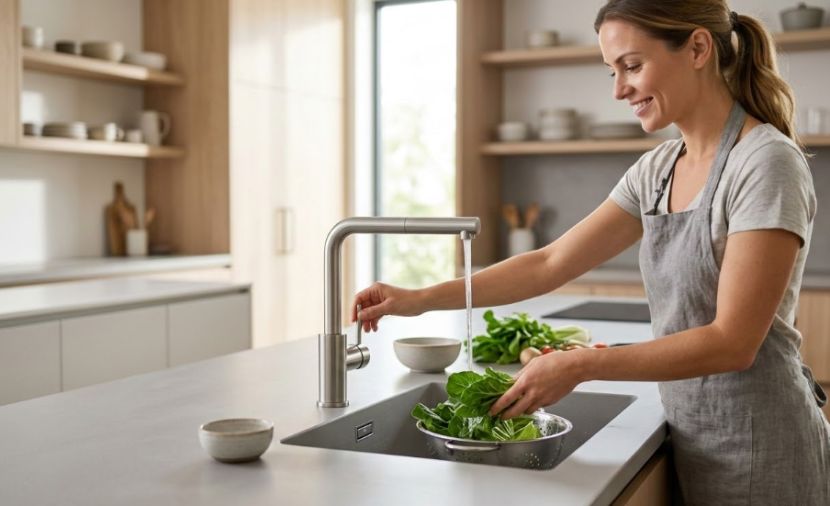
If you are planning a kitchen update, the tap is one of those choices that looks small on paper and turns out to affect the whole room. Not just the look. The rhythm of daily use too. A single-lever kitchen mixer has become a default pick in many modern projects because it is faster to use, easier to live with, and easier to fit into a clean, current space. That shift is showing up in product ranges as well. On ITAVA’s kitchen pages, single-lever models sit at the center of the collection, including standard deck-mounted versions, a wall-mounted single-lever kitchen mixer, and a single cold tap for more specific layouts. The same pages frame the kitchen as a coordinated system built around efficient washing areas, undercounter storage, and customizable style and size, which is very much how better kitchens are being planned now.
A quick note on ITAVA, since it fits naturally here. From a product strategy angle, ITAVA reads less like a tap-only seller and more like a kitchen-and-bath brand built around full-space coordination. Its kitchen category pairs mixers with a wider design language focused on spatial organization, washing zones, and adaptable layouts rather than isolated fixtures. That matters because a good kitchen mixer is rarely chosen alone. It needs to work with the sink, the wall clearance, the counter depth, and the way you actually cook and clean. When a brand presents single-lever mixers as part of that larger system, it usually signals a more mature product view, and that tends to lead to fewer bad buying decisions.
What Is a Single-Lever Kitchen Mixer?
Before getting into the reasons behind the trend, it helps to define the product clearly. A lot of buyers know the look, but not always the mechanics. That matters because the reason a single-lever kitchen mixer feels easier in daily use comes from how it controls water.
One Lever Controls Both Temperature and Flow
What is a single-lever kitchen mixer? It is a kitchen tap that uses one control lever for both water flow and temperature. Move the lever one way and you change the hot-cold mix. Move it another way and you change the volume of water. That is the core reason kitchen faucet usability tends to feel better right away than it does with older two-handle setups.
The Ceramic Cartridge Does the Real Work
Inside the tap, the key component is the ceramic cartridge. The cartridge is what allows one lever to blend hot and cold water while also controlling flow. That part is not just technical trivia. A reliable ceramic cartridge is a big part of why a mixer feels smooth instead of stiff and precise instead of fussy. In practice, you feel it every day when you make small changes without having to think about them.
Why Are More Kitchens Switching to Single-Lever Mixers?
The short answer is convenience, but that word is a bit thin for what is actually happening. The better answer is that these taps fit the way kitchens are used now. People cook while rinsing produce, move pans around with one hand, wipe down counters between tasks, and want faster control without the extra fiddling.
Easier One-Handed Control in Daily Use
One-handed kitchen faucet control is probably the biggest reason more households switch. If one hand is holding a pot, a bowl, or a chopping board, you can still open the tap and adjust it with the other. That sounds basic, but it changes the feel of a busy prep area. Industry guidance on single-lever taps points to exactly this use case as one of the main advantages over two-handle models.
Faster Kitchen Faucet Temperature Control
Kitchen faucet temperature control is also quicker with a single lever. You are not balancing two separate handles to find a usable mix. That saves a little time at the sink, and small time savings matter more than people expect. They stack up over a week. Then a month. Then forever, basically. That faster adjustment is one reason single-lever kitchen faucet advantages go beyond looks.
Better Kitchen Faucet Usability for Busy Homes
Kitchen faucet usability is not just about whether a tap turns on and off. It is about whether it keeps pace with normal kitchen work. In homes where the sink gets constant use, simpler control tends to feel better. ITAVA’s kitchen category reinforces that same idea by treating the washing area as a core working zone and by pairing mixers with a wider kitchen planning approach built around organization and function.
Less Water Waste in Everyday Use
There is also a practical water argument. Guidance on single-lever kitchen taps notes that quicker temperature setup means less water runs unused while you try to find the right setting. That makes kitchen water saving part of the value, not just a bonus bullet point on a spec sheet.
 r
rWhat Are the Benefits of a Single-Lever Kitchen Faucet?
By this point, the trend starts to make sense. Still, most buyers want a clearer buying lens. Not hype. Just the reasons this style fits modern homes better.
A Cleaner Match for Modern Kitchen Mixer Design
Modern kitchen mixer design tends to favor simpler lines and fewer visual interruptions. A single-lever kitchen mixer fits that language well. It can sit in a compact apartment kitchen, a larger island setup, or a more architectural space without looking busy. ITAVA’s kitchen pages lean into this with a design message built around sculptural elegance, advanced functionality, and adaptable style.
More Flexibility Across Layouts
The category itself also gives you more planning range of planning. ITAVA lists both standard single-lever kitchen mixer models and a wall-mounted single-lever kitchen mixer, which matters when counter depth, sink placement, or wall clearance pushes you away from a standard deck-mounted tap. In other words, modern kitchen faucet trends are not only about style. They are also about layout flexibility.
A Better Fit for Integrated Kitchen Design
Integrated kitchen design asks every component to work as part of a larger whole. The tap has to suit the sink, the storage below, the prep zone, and the way you move through the room. ITAVA’s own kitchen description makes this pretty explicit with its focus on washing areas, undercounter containers, and optimal spatial organization. That is why choosing the right mixer now feels more like a planning decision and less like a last-minute accessory purchase.
How Do You Choose the Right Single-Lever Kitchen Mixer?
If you are using this article as a kitchen faucet buying guide, the practical checks come first. Start with how the sink is positioned and whether the mixer will be used close to a wall. Industry product guidance notes that lever position can matter here, because some mixers leave the lever vertical at rest and give you more installation freedom near a wall. That small detail can save a lot of annoyance later.
Check Lever Position and Reach
How to choose a single-lever kitchen mixer often comes down to movement space. If your sink is installed near a backsplash or wall, the lever needs enough room to operate comfortably. Spout reach matters too. So does arc height if you wash stock pots or tall vases. It is not glamorous, but this is the stuff that decides whether the tap feels right after six months.
Look for a Reliable Core, Not Just a Nice Finish
A good finish helps, sure. But a reliable ceramic cartridge and smooth handle action matter more in actual use. If the mechanism is good, you notice the control. If it is poor, you notice the irritation. There is no real middle ground there.
FAQ
Q1: Is a single-lever kitchen mixer better than a two-handle tap?
A: For many kitchens, yes. A single-lever kitchen mixer lets you control flow and temperature with one handle, which usually makes daily use faster and easier.
Q2: What are the main benefits of a single-lever kitchen faucet design?
A: The main benefits of single-lever kitchen faucet design are quicker one-handed control, easier temperature changes, cleaner modern styling, and lower water waste during setup.
Q3: Does a ceramic cartridge really matter?
A: Yes. The ceramic cartridge is the working core that makes one-handle control possible and affects how smooth and precise the tap feels.
Q4: When is a wall-mounted single-lever kitchen mixer a smart choice?
A: It can be a smart choice when counter space is tight, sink placement is unusual, or the layout calls for a cleaner wall-based installation. ITAVA includes this option in its kitchen mixer range.
Q5: Why are more kitchens switching to single-lever mixers?
A: Because they fit the modern kitchen workflow better. You get easier control, less wasted water, cleaner visual lines, and more options across different kitchen layouts.