

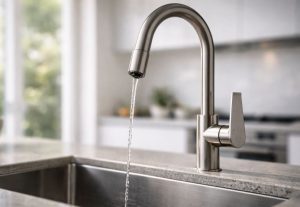
Completing a modern kitchen renovation often ends with the installation of a stunning, tall high-arc mixer. It looks like it belongs in a professional chef’s station, creating high expectations for performance. However, lifting the handle sometimes results in a weak, frustrating trickle rather than a powerful cascade.
This puzzles folks, mainly when bathroom taps in the same place run just fine.
If a fresh kitchen faucet has low water flow, people quickly point fingers at the home’s water pressure.
However, the reality is usually mechanical. High-arc faucets have a unique internal geometry that naturally resists flow.
Here is an engineering look at why this faucet low flow problem occurs and where the bottlenecks are hiding.
1. The Physics of the “High Arc” (Geometry & Gravity)
First, we have to look at the design itself. A standard bathroom tap is short and direct, meaning the water travels only a few inches from the valve to the exit.
A high-arc kitchen mixer is different. The water has to travel up a long neck, often 40cm or higher, fighting gravity the whole way. It then has to make a tight 180-degree turn at the top to come back down.
From a fluid dynamics perspective, every centimeter of tubing and every sharp bend adds “friction loss.” If the internal channel of the spout is rough, this drag increases. This geometry naturally reduces the overall kitchen faucet flow rate compared to a shorter tap. To overcome this, engineers must design professional kitchen mixers with wider internal channels to compensate for the height.
The Aerator: The First Suspect
If flow feels weak right after setup, dirt is nearly always the cause.
In a remodel, shutting the main water valve on and off stirs dirt and buildup in old pipes. When water starts again, this junk races up the line and strikes the first screen: the kitchen faucet aerator.
Modern aerators are also designed as flow restrictors to meet water codes. Even a tiny amount of grit can block these small mesh holes, causing sudden sink faucet low flow.
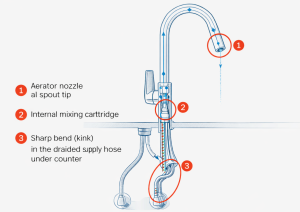
The Test: Unscrew the aerator at the tip of the spout. Turn the water on. If the flow is suddenly strong, the plumbing is fine. The bottleneck is strictly in that small component at the tip.
3. Supply Lines: The Invisible Choke Point
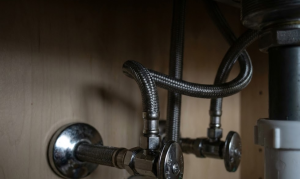
Sometimes, the restriction is hidden out of sight, underneath the sink cabinet. When diagnosing a persistent faucet low flow problem, looking under the sink is just as important as looking at the spout.
Instead of a single bottleneck, there are often four distinct “invisible” choke points in the supply system:
- The Braided Hose Bore Size: In the B2B world, variation is significant. Two hoses might look identical on the outside, but the internal tube (bore size) can be vastly different. Cheap hoses often have a tiny internal diameter—sometimes as narrow as 6mm—which physically strangles the water volume.
- The “Kink” Risk: High-arc faucets often feature a pull-down sprayer with a long hose looping under the sink. If the counterweight is placed incorrectly, this hose can bend sharply when the spray head is docked, cutting off flow like a stepped-on garden hose.
- Integrated Check Valves: Most modern pull-down mixers require non-return valves to prevent backflow. These small, spring-loaded mechanisms are often hidden inside the hose connection. Over time, calcium buildup can jam the spring, locking the valve in a semi-closed position.
- Angle Valves (Stop Cocks): Do not ignore the valves on the wall. In older buildings, the internal rubber washers in these valves can crumble and block the outlet. Always verify that the wall valves are fully open and debris-free before dismantling the faucet.

4. The Cartridge Capacity
Finally, consider the engine of the faucet: the cartridge.
Not all 35mm cartridges are built to handle high volume. Some are designed specifically for eco-friendly, low-flow applications. If a restrictive cartridge is installed in a home with gravity-fed (low) pressure, the result will always be disappointing.
Furthermore, if the cartridge is damaged or clogged, it can restrict flow just as easily as it can cause leaks.
Conclusion
Solving a faucet low flow problem is rarely a mystery; it is a math problem involving friction and restriction. It is usually the sum of a restrictive aerator, a narrow supply hose, or a kink under the sink.
Before ripping out the plumbing, check the simple things first. Clean the aerator and inspect the hoses for bends. For the best long-term experience, ensure the installation uses well-engineered units like the Alva Series Single Lever Mixer, which is designed with optimized internal routing to handle these hydraulic challenges.
ITAVA understands that a kitchen faucet is a functional tool, not just a design object. Since 2010, the engineering team has utilized fluid dynamic testing to minimize internal friction in high-arc designs. By selecting Neoperl aerators that resist sediment buildup and using larger-bore supply lines as standard, ITAVA ensures that visual grandeur matches hydraulic performance. The focus is on delivering a consistent, satisfying stream, even in systems with lower baseline pressure.
FAQ
Q1: Why is my kitchen tap pressure low but the bathroom is fine?
A: The kitchen tap usually has a finer flow restrictor and a longer path for the water to travel. Also, debris from the pipes often hits the kitchen aerator first because it is the most used fixture.
Q2: Will removing the aerator fix the pressure?
A: It will increase the flow, but the water will splash everywhere and the stream will be messy. A better fix is to clean it or buy a “high flow” replacement aerator.
Q3: Can the pull-down hose cause low pressure?
A: Yes. If the weight under the sink is in the wrong spot, it can pinch the hose shut when the head is sitting in the holder.
Q4: Do larger supply hoses make a difference?
A: Absolutely. Switching from a narrow 6mm hose to a 10mm hose allows much more water volume to reach the mixer, which helps maintain pressure.
Q5: Is it the hot water or the cold water that is low?
A: If only one side is low (e.g., hot is weak, cold is strong), the issue is likely a blocked inlet filter or a kinked supply hose on that specific side, not the faucet itself.