

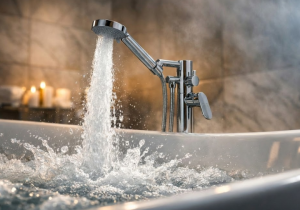
You step into the shower expecting a powerful blast of hot water. Instead, you get a weak, sad drizzle. Frustrating, right?
Or perhaps you set up a nice free-standing tub. You twist the knob. Yet it takes ages to fill up. The water comes out in a tiny stream.
If you face low water pressure in the shower, you are not by yourself. It is a big pain for home owners.
Most people blame the city water or think a pipe burst underground. But here is the truth: the problem is often right inside your bathroom. The culprit might be the fixture itself. If you’ve asked, “What causes low water pressure in the shower?”, the answer is likely your mixer design.
Here is why your pressure drops and how to get better water pressure in the shower by picking the right gear.
1. The Basics: Is It a Plumbing Issue or a Mixer Issue?
Before blaming the faucet, let’s rule out the easy stuff. What causes low water pressure in the shower issues related to your house pipes?
- Dirty Showerheads: Hard water leaves behind minerals. This “gunk” clogs the nozzle holes.
- Sudden Drops: Did you experience a sudden loss of water pressure in the shower? If it was fine yesterday but dead today, that’s usually a burst pipe or a closed valve.
- Hot Water Only: Asking “what causes low hot water pressure in the shower” specifically? If the cold water is strong, your water heater might be clogged with sediment.
But what if your pipes are fine? If you have a new bathroom and the flow is still weak, the issue is your mixing valve.
2. Can a Shower Mixing Valve Cause Low Water Pressure?
Yes.
Many people think all faucets flow the same. They don’t. A cheap mixer acts like a bottleneck. It squeezes the water flow, killing your pressure.
So, can a shower mixing valve cause low water pressure? Absolutely. Here is why:
- Tiny Channels: Cheap mixers have narrow waterways inside. It’s like forcing four lanes of traffic into one. The speed drops fast.
- The Cartridge: Can a bad shower cartridge cause low water pressure? You bet. The cartridge is the engine inside the handle. Standard ones have small holes that limit water. For a good shower, you need a high flow rate shower mixer. These have special cartridges designed to let more water through.
3. The Specific Challenge with Freestanding Bathtubs
Floor-mounted tubs look great, but they fight gravity. The water has to travel way up from the floor.
Lazy installers often use flimsy, flexible hoses to connect them. If these hoses aren’t supported, they kink under the floor tiles like a bent garden hose. This physically blocks the water. It’s a common reason for permanent low pressure in new baths.
The Solution: Stability and Flow Optimization
You want a strong flow? You need a stable installation. The method matters as much as the mixer.
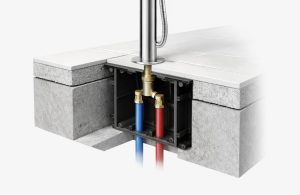
You need a tool like the floor-standing shower bath mixer with a concealed box.
Standard mixers can wobble and rely on loose hoses. High-quality systems use a Concealed Box.
Think of the box as a foundation.
- Stability: It anchors the plumbing in the concrete. No wobbling.
- Straight Flow: It stops pipes from getting squished. It keeps a clear, straight path for the water so it hits the mixer with full force.
5. How to Get Better Water Pressure in the Shower (Checklist)
Fixing up your bathroom? Don’t waste money on weak faucets. Use this checklist.
- Know Your Home: Gravity-fed systems (low pressure) need different faucets than combi-boilers (high pressure).
- Go Big: Shop for a high flow rate shower mixer. Ask for a 35mm or 40mm cartridge. Bigger is better.
- Buy Brass: Cheap metal creates drag. Solid brass bodies are smoother inside. You can browse a complete collection of high-performance bathroom fixtures to find solid brass models that maximize flow.
- Use a Box: For floor-standing taps, always use an installation box. It guarantees the water flows freely.
Conclusion
Don’t settle for a drip. Life is too short for bad showers.
Often, the fix isn’t a plumber; it’s just better hardware. Choose engineering over low prices. Get the flow you deserve.
Experience the ITAVA Difference
Unlike plain sellers, ITAVA watches every part of the making process. From low-pressure casting to high-grade electroplating, the firm makes sure items meet tough world rules like cUPC, CE, and WaterSense.
Whether giving the right fixtures for a fancy hotel or fixes for a home owner sick of changing heat, ITAVA joins lasting strength with nice style. The firm does not just sell taps. It builds trusty water send systems made to work well for years. This is why folks around the world count on ITAVA for their hardest bath room jobs.
FAQ
Q1: Why is my shower pressure low with new pipes?
A: It’s likely the mixer. Many modern faucets have “restrictors” inside to save water, or they are just built with narrow tubes. This acts like a brake on your water flow.
Q2: Can a bad cartridge really kill the pressure?
A: Yes. If the cartridge gets clogged with dirt, or if it’s just a small, cheap model, it blocks the water physically. It turns a blast into a trickle.
Q3: My hot water is weak but cold is fine?
A: That’s a heater issue, not a shower issue. Check your water heater for sediment buildup, or make sure the valve on the hot water pipe is fully open.
Q4: How do I spot a “high flow” mixer?
A: Check the cartridge size! Look for 35mm or 40mm specs. Also, feel the weight. Heavy, solid brass mixers usually have better internal casting than light plastic ones.
Q5: Do I really need a concealed box for my tub filler?
A: We think so. Without it, your connections are just loose hoses under the floor. They kink and leak. The box keeps everything rigid and keeps the water flowing fast.